• Welcome to the LegalBeagles Consumer and Legal Forum.
    Please Register to get the most out of the forum. Registration is free and only needs a username and email address.
    REGISTER
    Please do not post your full name, reference numbers or any identifiable details on the forum.

Swift Advances Plc?

Collapse
Loading...
X
  • Filter
  • Time
  • Show
Clear All
new posts

  • Guest's Avatar
    Guest replied
    Re: Swift Advances Plc?

    To illustrate from the OFT guidence on the 2006 ammendments

    Section 21: Interpretation of ss.140A and 140B of the 1974 Act
    50.
    Section 21 inserts a new section 140C after the new section 140B (inserted
    into the 1974 Act by section 20). The new section 140C defines the types of
    agreements that are covered by sections 140A and 140B. Any agreement that
    involves the provision of credit to an individual, whether or not regulated by the 1974
    Act (except as specified (see paragraph 48 above)), is covered. The sections also
    cover, through the definition of “related agreement”, the practice where the creditor
    enters into successive credit agreements with a debtor for the purpose, for example, of
    increasing the total amount of the debt or obtaining multiple fees from the debtor for

    setting up each loan.

    Peter

    Leave a comment:


  • Sparkie1723
    replied
    Re: Swift Advances Plc?

    Originally posted by peterbard View Post
    Hi

    So this explains why the first motguage is exempt and the second one is not under secion 16 c.
    The good news i think is that this means that section 140 will apply so hopefully all those bits of information about the reptiles who have given you this agreement will be applicable for evaluation under the unfair terms regulaions.

    Unless i am wrong,which is possiblle.
    Peter

    Had a conversation with one of the secured lending team investigators this afternoon and explained about the condition stating that it states that it is a legal mortgage charge with full title rights ...exactly what our First mortgage states.
    The restriction on our deeds by each mortgagor are exactly the same. Abbey have an FSA licence Swift Advances plc do not.

    He made notes as he had their conditions of the charge in front of him as we spoke.

    He said that he would obtain the answer from their legal team which as you know consists of Barristers and solicitors who can define the Act....especially now that the OFT is a corporate body...........no longer has a registrar general they have a full board of Directors..
    They cannot give independant legal advice but as this would affect thousands of borrowers they will more than likely define the answer

    Sparkie
    Last edited by Sparkie1723; 11th July 2011, 19:59:PM.

    Leave a comment:


  • Guest's Avatar
    Guest replied
    Re: Swift Advances Plc?

    Hi

    So this explains why the first motguage is exempt and the second one is not under secion 16 c.
    The good news i think is that this means that section 140 will apply so hopefully all those bits of information about the reptiles who have given you this agreement will be applicable for evaluation under the unfair terms regulaions.

    Unless i am wrong,which is possiblle.
    Peter

    Leave a comment:


  • jumper999
    replied
    Re: Swift Advances Plc?

    Good luck sparkie and bloody well done for your determination in this fight.

    If I had half the spirit and courage as you have at your age then I will elect myself in taking David Cameron's place at number 10.

    Leave a comment:


  • Guest's Avatar
    Guest replied
    Re: Swift Advances Plc?

    Agreements secured on land
    3.3 The Act does not regulate:


    a regulated mortgage contract, or regulated home purchase plan,

    within the meaning of the Financial Services and Markets Act

    2000,23

    THis is the above act. i have highlighted the relevant bits

    61.—(1) Entering into a regulated mortgage contract as lender is a specified kind of activity.
    (2) Administering a regulated mortgage contract is also a specified kind of activity, where the contract was entered into after the coming into force of this article.
    (3) In this Chapter—
    (a)a “regulated mortgage contract” means a contract under which—
    (i)a person (“the lender”) provides credit to an individual or to trustees (“the borrower”); and
    (ii)the obligation of the borrower to repay is secured by a first legal mortgage on land (other than timeshare accommodation) in the United Kingdom, at least 40% of which is used, or is intended to be used, as or in connection with a dwelling by the borrower or (in the case of credit provided to trustees) by an individual who is a beneficiary of the trust, or by a related person;
    (b)“administering” a regulated mortgage contract means either or both of—
    (i)notifying the borrower of changes in interest rates or payments due under the contract, or of other matters of which the contract requires him to be notified; and
    (ii)taking any necessary steps for the purposes of collecting or recovering payments due under the contract from the borrower;
    but a person is not to be treated as administering a regulated mortgage contract merely because he has, or exercises, a right to take action for the purposes of enforcing the contract (or to require that such action is or is not taken);
    (c)“credit” includes a cash loan, and any other form of financial accommodation.
    (4) For the purposes of paragraph (3)(a)(ii)—
    (a)a “first legal mortgage” means a legal mortgage ranking in priority ahead of all other mortgages (if any) affecting the land in question, where “mortgage” includes charge and (in Scotland) a heritable security;
    (b)the area of any land which comprises a building or other structure containing two or more storeys is to be taken to be the aggregate of the floor areas of each of those storeys;
    (c)“related person”, in relation to the borrower or (in the case of credit provided to trustees) a beneficiary of the trust, means—
    (i)that person’s spouse;
    (ii)a person (whether or not of the opposite sex) whose relationship with that person has the characteristics of the relationship between husband and wife; or
    (iii)that person’s parent, brother, sister, child, grandparent or grandchild; and
    (d)“timeshare accommodation” has the meaning given by section 1 of the Timeshare Act 1992 (1).

    This is not bad news in my opinion.

    More later

    Peter

    Leave a comment:


  • Sparkie1723
    replied
    Re: Swift Advances Plc?

    Hi Dougal
    Thanks for the previous post ...I think now the screws are being turned tighter by the minute.....it means they increased my partners income by £2685.18 Per Annum.
    I'm just waiting for the next contact from the Cheshire Police

    Sparkie

    Leave a comment:


  • Dougal16T
    replied
    Re: Swift Advances Plc?

    Sparkie, and all my colleagues on Beagles

    I have said this many times: Your last post is the clearest indication I have ever seen (as A PC and afterwards as a Civil Prosecutor for the Crown), that the offence here is

    Obtaining a pecuniary advantage

    s16 TA68 states that:
    (1) A person who by any deception dishonestly obtains for himself or another any pecuniary advantage shall on conviction on indictment be liable to imprisonment for a term not exceeding five years.
    (2) The cases in which a pecuniary advantage within the meaning of this section is to be regarded as obtained for a person are cases where:-
    (a) Repealed by s5(5) Theft Act 1978;
    (b) he is allowed to borrow by way of overdraft, or to take out any policy of insurance or annuity contract, or obtains an improvement of the terms on which he is allowed to do so; or
    (c) he is given the opportunity to earn remuneration in an office or employment, or to win money by betting
    (3) For the purposes of this section "deception" has the same meaning as in section 15 of this Act.
    The elements of the actus reus are similar to the offence of obtaining property by deception: there must be a deception – this has the same meaning as for s.15 (according to s.16(3) TA 1968) there must be causation – as above there must be the obtaining of a pecuniary advantage. The only definition of "pecuniary advantage" is offered in s16(2): (a) (repealed by TA 1978); (b) a person is allowed to borrow by way of overdraft, or to take out a policy of insurance or annuity contract, or obtains an improvement of the terms on which he is allowed to do so, or (c) a person is given the opportunity to earn remuneration or greater remuneration in an office or employment, or to win money by betting. Section 16(2)(b) covers the situation in MPC v Charles above where writing the cheque backed by a card obtains an unauthorised overdraft even though the deception operates on the mind of the person accepting the cheque and not on the mind of a bank officer. In most cases, the granting of credit may be machine-based with reference to a bank officer only being made when larger sums of money are involved. Where the pecuniary advantage is the obtaining of an overdraft facility at a bank, it is only necessary to show that the facility was granted, not that the defendant actually used the facility.
    Section 16(2)(c) clearly covers those people who claim to have qualifications which are in fact false, and because of these qualifications they are employed. Further, according to R v Callender (1992) CLR 591 where a self-employed accountant made deceptions, the section was held to apply equally to employment as an independent contractor and employment as a servant. The defendant is charged under s16 if the deception is detected before payment is made. Thereafter, the defendant has obtained payment under s15. As to betting shops, if the defendant goes into the shop just before the horse race is due to start, places the bet and very slowly begins to count out the stake money as the commentary relays the progress of the horses, the opportunity to win has been obtained and the defendant can be convicted if they pick up the money and run out when it becomes obvious the nominated horse will not win.
    [edit]Mens rea
    There are two elements to the mens rea of this offence:
    there must be a deliberate or reckless deception (see above)
    the defendant must be dishonest (see above).
    But there is no need to prove an intention to permanently deprive.
    [edit]References

    Allen, Michael. Textbook on Criminal Law. Oxford University Press: Oxford. (2005) ISBN 0-19-927918-7.
    Criminal Law Revision Committee. 8th Report. Theft and Related Offences. Cmnd. 2977
    Law Commission Consultation Paper No.15. Fraud and Deception. (October, 1999) [2]
    Griew, Edward. Theft Acts 1968 & 1978, Sweet & Maxwell: London. ISBN 0-421-19960-1
    Ormerod, David. Smith and Hogan Criminal Law, LexisNexis: London. (2005) ISBN 0-406-97730-5
    Smith, J. C. Law of Theft, LexisNexis: London. (1997) ISBN 0-406-89545-7.
    Smith, J. C. Obtaining Cheques by Deception or Theft (1997) CLR 396
    Smith, J. C. :Stealing Tickets (1998) CLR 723

    Although this is no longer in the Theft Act, it is now found in the Fraud Act 2006 under


    Section 2 Fraud by false representation

    (1)A person is in breach of this section if he—

    (a)dishonestly makes a false representation, and

    (b)intends, by making the representation—

    (i)to make a gain for himself or another, or

    (ii)to cause loss to another or to expose another to a risk of loss.

    (2)A representation is false if—

    (a)it is untrue or misleading, and

    (b)the person making it knows that it is, or might be, untrue or misleading.

    (3)“Representation” means any representation as to fact or law, including a representation as to the state of mind of—

    (a)the person making the representation, or

    (b)any other person.

    (4)A representation may be express or implied.

    (5)For the purposes of this section a representation may be regarded as made if it (or anything implying it) is submitted in any form to any system or device designed to receive, convey or respond to communications (with or without human intervention).

    There is no longer any requirement to prove 'intent' of the person committing the Fraud.

    I think this says it all, and if I were Swift staff members I would be seriously thiinking of putting mu head between my legs and kissing my a**e goodbye!!

    Best wishes to my fellow Beagles

    Dougal

    Leave a comment:


  • Sparkie1723
    replied
    Re: Swift Advances Plc?

    It is my understanding that a legal mortgage with full title rights is that both the loan/mortgage agreement AND the Title deed must be witnessed by a solicitor ........would/could anyone confirm this?
    If This is correct then this is another problem for Swift Advances plc

    Sparkie

    Leave a comment:


  • Sparkie1723
    replied
    Re: Swift Advances Plc?

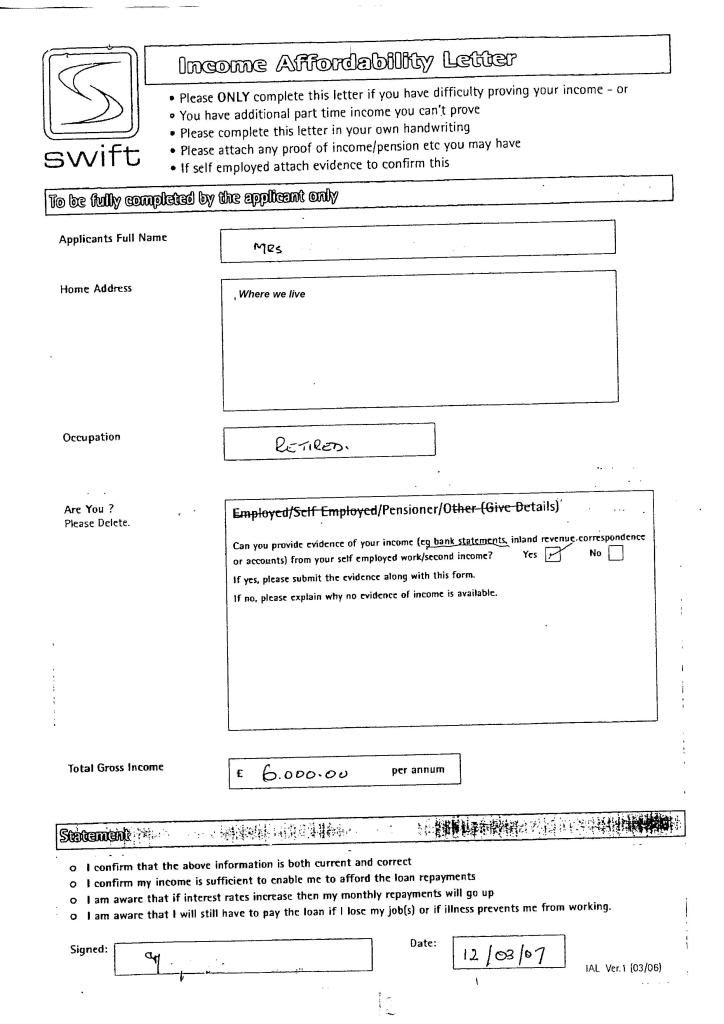
    My partners signed income declaration form showing £6000 per year which is £500 a month ...not what Swift Advances plc altered it to

    We were 70 years old when we applied and I was still working and in good health.....so I thought but then suffered a bad heart attack.... ended up in intensive care and warned not to work again or it would kill me......so I finished work

    Last edited by Sparkie1723; 11th July 2011, 17:07:PM.

    Leave a comment:


  • Sparkie1723
    replied
    Re: Swift Advances Plc?

    This what Swift Advances plc sent as our underwiting sheet.............this is their idea of transparency.


    The commission that would have been paid is under the blocking out at the top r/h Corner
    There are two certain authorities who are more than a little amazed that any lender would hope to have this accepted by anyone
    The blocking out in the box on r/h side where the incomes are stated is where incomes and outgoings are stated ...the % of outgoings in relation to income
    The box on the L/H side contains our house value and equity in it
    It contains who our First Mortgage is with ...if there are any arrears ...the £100 packaging fee Admin fee lots of info we are legally entitled to

    The £803.86 is where they manipulated my partners pension from £500 a month up to £803.86 when she had declared £6000 per annum ......they decided it wasn't enough and added the extra to make it appear we afford the loan repayments.

    I post her signed income declaration later just for proof No "lies"??? are being told.......unlike some I could mention

    Sparkie

    Last edited by Sparkie1723; 11th July 2011, 16:17:PM.

    Leave a comment:


  • Sparkie1723
    replied
    Re: Swift Advances Plc?

    Originally posted by peterbard View Post
    Well now there is a thing. Wonder if i can dig out the corresponence from the OFT. It was a few years ago, but i would bet the definition in Goode would be the same.

    Peter

    It would be wonderful if you could Peter...............The thing is Swift Advances plc do not hold an FSA licence.............that would be construed as carrying out morgage business without a licence

    Sparkie

    Leave a comment:


  • Guest's Avatar
    Guest replied
    Re: Swift Advances Plc?

    Originally posted by Sparkie1723 View Post
    Thanks for that also Peter

    The First Condition of Swift Advances plc conditions of the charge starts with and states this


    1. You charge the property to us by way of legal mortgage with full title guarantee.

    Swift Advances plc wording on our title deeds is exactly the same as made by our first mortgage holder Abbey National ...now Santander

    I think this qualifies and quantifies that it is an exempt agreement not "unregulated" and would/should fall under the remit of the FSA and rules laid down by the MCOL??

    Sparkie
    Well now there is a thing. Wonder if i can dig out the corresponence from the OFT. It was a few years ago, but i would bet the definition in Goode would be the same.

    Peter

    Leave a comment:


  • Sparkie1723
    replied
    Re: Swift Advances Plc?

    Originally posted by peterbard View Post
    HI Sparkie

    I thought i saw a mention of section 18 in an earlier post. NO matter. Yes section16 does exempt loans secured by land morgage, had this debate with the oFT some years ago, they said that the key is the word mortguage, the first loan purposeis to seccure a morguage whilst the second loan is usually not and therefore not exempt.
    Cant remember mentioning penalty charges

    Best regards
    Peter
    Thanks for that also Peter

    The First Condition of Swift Advances plc conditions of the charge starts with and states this


    1. You charge the property to us by way of legal mortgage with full title guarantee.

    Swift Advances plc wording on our title deeds is exactly the same as made by our first mortgage holder Abbey National ...now Santander

    I think this qualifies and quantifies that it is an exempt agreement not "unregulated" and would/should fall under the remit of the FSA and rules laid down by the MCOL??

    Sparkie
    Last edited by Sparkie1723; 11th July 2011, 12:50:PM.

    Leave a comment:


  • Guest's Avatar
    Guest replied
    Re: Swift Advances Plc?

    HI Sparkie

    I thought i saw a mention of section 18 in an earlier post. NO matter. Yes section16 does exempt loans secured by land morgage, had this debate with the oFT some years ago, they said that the key is the word mortguage, the first loan purposeis to seccure a morguage whilst the second loan is usually not and therefore not exempt.
    Cant remember mentioning penalty charges

    Best regards
    Peter

    Leave a comment:


  • Sparkie1723
    replied
    Re: Swift Advances Plc?

    Originally posted by peterbard View Post
    Should really stop and think a bit before I comment but what the hell we are all friends here.
    I hate saying in my opinion because these comments are of course my opinion I am not a glove puppet.
    I think you are quite right there is no such animal as an unregulated agreement; it is just an agreement, and as such subject to common law and any statue that does not specifically say it does not apply.
    Also you are correct in saying that the agreement requires a licence just because It is not covered by the act does not mean it is not a consumer credit agreement.
    I noticed earlier an oblique mention of section18 in regards to fees and such, personally I would forget that particular angle, test cases which I won’t bore you with have pretty mush seen of the section 18 argument.
    I do think you should look into the charge for credit angle though, if you haven’t already, yes i know that this is a CCA concept but the reason that it is included in the CCA is because it is about fairness. Basically they should not charge you interest on an amount that you have not benefited from.
    It may be totally above board the only way to check is look at the figures, it depends on the ratio between the “total charge for credit” and the amount you took away with you as your loan, this should of course be your APR.
    If these three does not co relate then the agreement is incorrectly executed, yes I know, a cca term, but unfair if incorrect nevertheless.
    I am not altogether convinced about your argument re the naming requirements under registration, but I have not really given it enough thought.
    Anyway I will constinue pondering
    Best regards
    Peter

    Sorry Peter,.......
    The penalty fees I refer to are the ones charged by the non existent unlicensed trading name of Eastern Counselling Department.


    I was referring to Section 16 in that the Act says any loan secured on land is an exempt agreement and I argue that it is in the same manner that a First Charge mortgage is exempt and falls under the remit of the FSA......so should Swift Advances plc second charge loan/mortgage as it is secured on land


    Sparkie

    Leave a comment:

View our Terms and Conditions

LegalBeagles Group uses cookies to enhance your browsing experience and to create a secure and effective website. By using this website, you are consenting to such use.To find out more and learn how to manage cookies please read our Cookie and Privacy Policy.

If you would like to opt in, or out, of receiving news and marketing from LegalBeagles Group Ltd you can amend your settings at any time here.


If you would like to cancel your registration please Contact Us. We will delete your user details on request, however, any previously posted user content will remain on the site with your username removed and 'Guest' inserted.
Working...
X