
Re: Council Tax Liability Order Applications Court Costs – Test Case
From:
To: j-prentice@audit-commission.gov.uk
Sent: Friday, October 05, 2012 12:29 PM
Subject: North East Lincolnshire Council - Fraud
Dear Mr Prentice
I have been given your email address after contacting the audit commission's public enquiries team to establish the most appropriate department to forward correspondence.
As per my October 4 email, the correspondence are in relation to alleged fraudulent Magistrates' court costs charged to householders of North East Lincolnshire. Evidence is contained within the series of letters and has been obtained largely from researching cabinet documents and as a result of Freedom of Information requests.
As stated in my email, North East Lincolnshire Council's Head of Income and Payments Services (to whom I've sent these), has responded by stating she is not prepared to enter into further correspondence regarding the matter.
I have further evidence contained in a report I'm preparing about North East Lincolnshire householders being systematically defrauded. In this instance the alleged fraud is in connection with a bailiff firm contracted to the council which the authority, who are completely aware of this fact, use criminal methods and are consequently, clearly abetting this fraud. Please note that none of these details have been included in the correspondence I'm attaching to this email.
I have experienced some difficulty in identifying which organisation or department has jurisdiction for dealing with these matters and realise it may or may not be in your remit to investigate allegations of Fraud. I would therefore ask if it is not your jurisdiction, that concerns I've raised are recommended for investigation through another channel, be that the Police or the Serious Fraud Office for example.
In the case of the Serious Fraud Office, it must be borne in mind that the scale of the fraud will be such that many millions of pounds will be involved if all councils are accounted for. I have no doubt if researched in the same way North East Lincolnshire Council have, they will all be guilty to a greater or lesser degree.
Yours sincerely
Loading...
-
Re: Council Tax Liability Order Applications Court Costs – Test Case
From:
Sent: 04 October 2012 10:48
To: Public Enquiries
Subject: Local government
Dear Sir/Madam
There is a series of correspondence which I have sent to the Head of Income and Payments Services in regards to what seems to be fraudulent Magistrates' court costs charged to householders of North East Lincolnshire. The contents of the letters are the result of quite a bit of research into recent and past costs reviews with evidence from cabinet meeting minutes etc. Could you please advise me which is the most appropriate department to forward these correspondence to. The Head of Services I've already mentioned will not respond.
Yours sincerely
Dear Mr...
Thank you for your email.
I would suggest you send your correspondence to the Head of Audit or Director of Finance at the council concerned in respect of the precept for this magistrates court . Or alternatively contact the District Auditor who is John Prentice j-prentice@audit-commission.gov.uk who may be able to investigate as part of his remit.
Kind regards,
Public Enquiries Team
Audit Commission
1st Floor
Millbank Tower
Millbank
London SW1P 4HQLast edited by outlawlgo; 4th October 2012, 11:04:AM.Leave a comment:
-
Re: Council Tax Liability Order Applications Court Costs – Test Case
Just adding some information regarding my previous post.
The Summons which indicates that for last year's Council Tax liability there was an outstanding amount of £940.41. This in fact was not true. All payments had been made to the council before the "due by" date. The council had mistakenly sent my account for recovery and involved bailiffs, for which it later quashed the liability and court costs, but that is an entirely different issue.
For an update:
I was not able to make the payments by the 26 September, and so assume my instalment facility has been withdrawn and the balance of £437.52 is owing from that date.
It is unclear after comparing contents of the council's 12 September letter with information on its website, whether I should have received a summons by now.
Its website says "once instalments have been cancelled, a further seven days will be given to pay the full balance otherwise further recovery action will be taken". The letter says if payment is not made immediately a summons will be issued without any further notice and with £70 costs incurred.
Regardless of the above, no summons has been received yet. Maybe in the coming days it will arrive.Last edited by outlawlgo; 3rd October 2012, 10:29:AM.Leave a comment:
-
Re: Council Tax Liability Order Applications Court Costs – Test Case
North East Lincolnshire Council
Civic Offices Knoll Street
North East Lincolnshire
DN35 8LN
Ref: NG/CTR/12912
01 October 2012
Dear Ms ......
Re: Council Tax Reminder, Summons and Recovery – Account 550xxxxxxx
This letter will outline the concerns raised in my 28 September correspondence relating to Control & Monitoring. As mentioned, if any element of these costs is claimed with regards monitoring liability order applications, it will without doubt be done under false pretences.
It is a legal requirement for the council’s collection team to check the accuracy of all accounts before processing them to the enforcement stage. There is overwhelming evidence that the council does not meet this obligation. Data supplied by the council which relates to liability orders covering a five year period provides evidence that neither the local authority nor Magistrates’ court are monitoring liability order applications.
– 6,580 Liability Orders were issued for an initial debt of less than £100.
– For a debt less than £25 the number issued was 1,387. For outstanding balances under £15 the figure was 544, and 45 accounted for debts less than £5.
– 3 Liability Orders were even issued for an initial debt of only 1 penny.Over this period, a total 3,528 Liability Orders were issued for initial debt of £50 or less. The authority has stated that the council's collection team checks the accuracy of all accounts before passing them to the enforcement stage and accounts are only progressed to enforcement for amounts over £50.
Against the council’s own guidelines, 3,528 householders incurred court penalties that shouldn’t have. They would then be subjected to having their possessions seized by bailiffs and incurring further extortionate fees.
The financial benefit for letting these cases progress to enforcement is obvious. The court is paid for each application the council makes. It therefore makes financial sense for it to turn a blind eye and authorise applications and grant the orders.
Whether or not orders are sought purposely to generate income is a matter in itself for investigation, though what is relevant here is the negligence of both the council and court staff who review these cases. The point being that the annual £101,400 attributable to ‘Control & Monitoring’ will be costs claimed under false pretences as there clearly is no effective monitoring of liability order applications.
The case between "Regina v. Brentford Justices, Ex parte Catlin" made a point that "a decision by magistrates whether to issue a summons pursuant to information laid, involves the exercise of a judicial function, and is not merely administrative."
Lord Chief Justice, Lord Widgery stated that:
There clearly then, exists in these liability order applications, at least a dereliction of duty, when so many are granted for insignificant amounts. Many of which would likely have originated from administration errors or oversight rather than non-payment. Whatever the cause, these small debts certainly don't warrant being grossly inflated by council's court costs and bailiff fees.....before a summons or warrant is issued the information must be laid before a magistrate and he must go through the judicial exercise of deciding whether a summons or warrant ought to be issued or not. If a magistrate authorises the issue of a summons without having applied his mind to the information then he is guilty of dereliction of duty and if in any particular justices' clerk's office a practice goes on of summonses being issued without information being laid before the magistrate at all, then a very serious instance of maladministration arises which should have the attention of the Authorities without delay....
Defective Summons Documents
More evidence in this example reinforces the assertion that no Control & Monitoring exists in the liability order applications.

Having authorisation from the Magistrates’ court, the council’s recovery department sent out 3,361 flawed summonses containing incorrect and out of date information relating to costs for obtaining a liability order. The orders were for non-payment of either council tax or NNDR, with all alleged debtors scheduled to attend the same hearing of 2 June 2011.
Of greater concern is the Magistrates’ court had been informed by the council, in writing, that from 1 April 2011 it would be changing the composition of the costs by increasing the summons and no longer imposing £25 costs for obtaining the liability order – see September 17 letter.
The Magistrates courts' Legal Adviser is required to review applications which should have already been checked by the council's recovery staff beforehand. However, this had not prevented more than 3,000 of the defective summonses being sent out unnoticed to residents, stating that the council would apply for further costs of £25 if a liability order was granted. The obvious errors going unnoticed brings into question whether either of these procedures had even taken place.
Data obtained covering the five year period suggests it unlikely that any monitoring ever takes place.
A total £182,140 was incurred by 2,602 householders who were liable for the penalties in connection with a single council tax liability order hearing.
These court costs and any enforcement fees as a result of the recovery should not have been imposed. Firstly because the paperwork was flawed and secondly, it is unlikely applications had been checked by the council or reviewed by the court. Or, if they had this was done negligently.
In connection with enforcement, and as a follow-up to liability orders being issued by the Grimsby Magistrates’ Court on 2nd June 2011, the council had to re-send 2,207 letters which were sent out on the 3 June 2011. These documents, like the 3,361 summonses, were defective. If it was deemed necessary by the council to make corrections to these, then the summonses should have also been corrected and re-sent.
None of these defective summonses were corrected and re-sent when the council learned they were defective nor was any compensation made to residents in respect to costs incurred from this flawed judicial process.
Yours sincerelyLeave a comment:
-
Re: Council Tax Liability Order Applications Court Costs – Test Case
North East Lincolnshire Council
Civic Offices Knoll Street
North East Lincolnshire
DN35 8LN
Ref: NG/CTR/12912
28 September 2012
Dear Ms ......
Re: Council Tax Reminder, Summons and Recovery – Account 550xxxxxxx
I think it’s worth taking a look at the way Liability Order hearings are conducted and the role this plays in the obvious profiteering that goes on.
As you know these are typically scheduled to take place several times a year. What seems odd to me about the arrangement – and an indication that these are administrative rather than judicial affairs – is there being no requirement for the defendant to attend court. The ones who do, being typically low in number are met by council employees who are deployed at the court to intervene with proceedings.
Council’s court enforcement staff – having no connection with the court – will be in attendance to circumvent the judicial process. A room is reserved at court where council reps fashion their bogus hearing. This is a violation of due-process. Defendants who think they are to appear before Magistrates as stated on their summons have been duped. For those unfamiliar with these hearings, they may appear regular so would go along with the procedure.
Council staff will be either seeking payment plans or attempting to resolve mistakes made in their applications. However, those obstructed from presenting their cases before Magistrates, get no dispensation; costs would still stand and the Liability Orders obtained.
The council’s intrusion also doubles to limit time taken by Magistrates. Several weeks would be needed to process a single batch, should all defendants turn up knowing their rights. If everyone appeared, the court would still be in session when the subsequent batch was conveyored in. The council’s intervention clearly makes a complete mockery of the judicial process.
Gains generated through these "conveyor belt" style operations are enormous. It should raise alarm bells when revenue in respect of an hour or so's visit to the Magistrates’ court can mean the authority walks away with £0.21 million costs revenue if it achieves 3,000 complaints on its list to the court.
Having figures presented like this, makes it really hit home that the authority must benefit to a far greater extent from income generated than it incurs obtaining the orders. £1.13 million is therefore unrealistic as an amount the council incurs annually for sending out summonses.
For each liability order the council applies for, £3 is paid to HMCTS. This is the only amount that the council has, or is able to justify. The authority has stated this is included in the ‘Debt Collection’ category of its debt recovery budget. That leaves the remaining £1.09 million for sending out reminders and summonses and will cover letter printing, envelope enclosing, mailing costs and because of automation, little else.
The council tax regulations only allow reasonable costs to include those in connection with court applications. Therefore costs they might incur afterwards can not lawfully be charged to the debtor. For example if the authority incurs costs in relation to debt collecting operations, it would be unlawful to include that expenditure in the penalty imposed on the debtor.
It would be unlawful too for the council to cover its costs for sending out reminder and threat letters. Doing this would mean defendants subsidising late payers who in the majority would not incur costs.
To reinforce the assertion that only costs specifically connected with recovery can be reclaimed, the Council tax practice note number 9 states on page 8:
You could say this would mean costs which are not specifically attributable to recovery, like council tax administration in general, cannot be lumped in with the calculation and reclaimed by way of costs.3.18...The order will include the costs reasonably incurred by the authority in securing the order. Whilst it is likely that authorities will have discussed a scale of fees with the Clerk to Justices it should be recognised that the Court may wish to be satisfied that the amount claimed by way of costs in any individual case is no more than that reasonably incurred by the authority.
The council’s debt recovery budget states under ‘Control & Monitoring’ that 20% (£101,400) of the total £507,000 budget listed in that category is attributable to council tax recovery.
The concern is that an element of these costs may relate to monitoring of liability order applications. If so it is likely the costs claimed are being made under false pretences. I will be detailing this in a future correspondence.
Yours sincerelyLast edited by outlawlgo; 28th September 2012, 08:34:AM.Leave a comment:
-
Re: Council Tax Liability Order Applications Court Costs – Test Case
North East Lincolnshire Council
Civic Offices Knoll Street
North East Lincolnshire
DN35 8LN
Ref: NG/CTR/12912
27 September 2012
Dear Ms ......
Re: Council Tax Reminder, Summons and Recovery – Account 550xxxxxxx
I wrote previously about how historical levels of the summons and liability order provided evidence that costs for obtaining liability orders have been front loaded and are now being charged to residents at the summons stage of recovery.
What really gives the game away is not how much they’ve increased, but the weight given to the summons in relation to the liability order cost. This has shifted from being the lesser amount to the higher until ultimately the entire cost. It doesn’t take a genius to understand why they’ve been manipulated this way, but it does take away any credibility that they have any basis in reality.
I don’t see anything preventing an authority from electing not to charge for a liability order, but it would be unlawful if it were to specifically charge costs for a liability order at the summons stage.
The following table charts the changes of costs raised per summons and liability order over the period from 2000 to date. Note these are only in relation to council tax, NNDR are not included.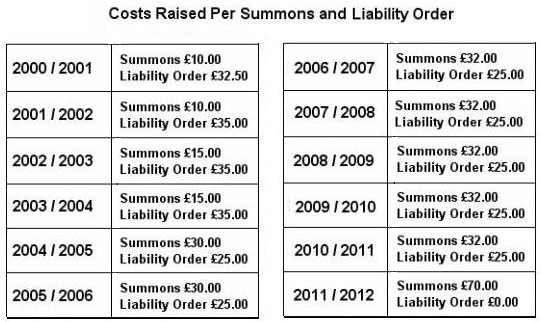
Up until 2011, 44% of the overall costs were charged to the debtor for obtaining a liability order.
Presently this is zero, so 100% is charged to the debtor for issuing a summons. The maneuver also saw the summons go up by almost 120%.
The radical change to the charging structure makes it a very real possibility that the law has been broken because householders charged for a summons are automatically incurring liability order costs whether an order is made against them or not.
The above figures supplied by NELC reveal that the authority has taken steps to increase revenue, not only by inflating costs, but by giving increased weight to the summons in relation to the overall costs. More importantly, they bring into question how the Magistrates' court, which is required to agree the level of costs, has been able to authorise these, with any credibility.
In 2001, liability order costs represented 78% of the overall costs, but decreased in 2002 to 70%.
In 2004 the scales tipped, and for the first time, more weight was given the summons penalty and the liability order costs were 45% of the overall costs.
These went largely unchanged until 2011 when the most radical shift in the proportion of costs occurred. The council, for whatever reason, regarded costs for obtaining a liability order were nil, which in contrast were deemed to be almost 80% of the overall costs in 2001. Now all these have been front loaded and are attributable to issuing the summons.
There have been five increases, and/or composition changes to the summons and liability order costs over this period. However, references to only two of these (2011 and 2002) have apparently been made publicly available through the council’s website.
Although some Cabinet documents are unavailable publicly, an additional one (2001) has been obtained. This one, along with the two available on its website are detailed in my September 18, 19 and 20 correspondence. In relation to the 2004 and 06 changes in the costs, no information is available and no cabinet documents are held at the council.
In all examples where there is documentation referencing the changes, it is clear that the hike in costs were not implemented as a consequence of increased costs incurred by the authority for issuing the summons.
Two noticeable observations can be made regarding the historical trend to gradually shift costs to the summons. One is that there could have been no justification for this, regardless of whether or not it was authorised by the Magistrates’ court, and the other of course is that increased revenue would be generated.
A quick comparison of the arbitrary way these costs are split will not solve the conundrum in terms of how they’re established, but it will demonstrate that the split between the two penalties is chosen randomly, and to best profit the council.
Establishing Costs – A ratio Perspective
22% of costs made up those imposed for the summons charge in 2001. Based on the then costs ratio and today’s figures, the summons should be around £15, based on overall costs of £70.
By imposing £70 for the summons, and using the ratio it favoured in loading costs in 2001, householders are being over charged £55 by the authority. This assumes costs are in fact £70 per summons. This though, is being proved will be nowhere near.
Of course the costs for the applications process will not be anywhere near those being claimed by the council. The example serves mainly to illustrate how the authority has been manipulating figures to suit itself.
Even if costs incurred by the council, up until issuing the summons exceeded the £70 charge, the council has specifically stated that:
Therefore, if not all, at least an element of these costs paid to HMCTS would be in respect to obtaining the liability order.Costs collected also cover monies paid to Her Majesty's Court Service for the use of their facilities.
So, regardless of whether or not the fee covers all incurred costs to the council, a disproportionate amount is collected in penalties from debtors who settle their accounts prior to possible court action.
Although there may be nothing to require that they do charge for the Liability Order, the council has now and historically – to varying degrees – given sufficient evidence that a distinction exists.
Yours sincerelyLast edited by outlawlgo; 27th September 2012, 09:01:AM.Leave a comment:
-
Re: Council Tax Liability Order Applications Court Costs – Test Case
North East Lincolnshire Council
Civic Offices Knoll Street
North East Lincolnshire
DN35 8LN
Ref: NG/CTR/12912
26 September 2012
Dear Ms ......
Re: Council Tax Reminder, Summons and Recovery – Account 550xxxxxxx
The attention here turns to a pretty much indisputable element of incurred costs. With almost 100% certainty, payment the authority makes to the Magistrates’ court for the use of its facilities can be justified. However, it’s uncertain if this expense relates to the summons, or costs traditionally associated with obtaining the liability order.
As was detailed in my letters of September 17 and 18, the council has made the liability order obsolete and front loaded all cost to the summons. The question, on a point of law, is whether costs specifically incurred by the council for obtaining the liability order are charged to the debtor as summons costs. If so, since front loading these charges, NELC will have been in breach of Regulation 34 of the Council Tax (Administration and Enforcement) Regulations 1992.
Historical records of changes in the composition of the summons and liability order costs, provides indisputable evidence that costs specifically for obtaining liability orders are now charged to the resident at the summons. This will be covered further separately, but for now I want to consider, where in the recovery process, payments to the court are incurred, but more importantly, where they should be incurred.Application for liability order
34.–(5) If, after a summons has been issued in accordance with paragraph (2) but before the application is heard, there is paid or tendered to the authority an amount equal to the aggregate of—the authority shall accept the amount and the application shall not be proceeded with.
(a) the sum specified in the summons as the sum outstanding or so much of it as remains outstanding (as the case may be); and
(b) a sum of an amount equal to the costs reasonably incurred by the authority in connection with the application up to the time of the payment or tender,
(6) The court shall make the order if it is satisfied that the sum has become payable by the defendant and has not been paid.
(7) An order made pursuant to paragraph (6) shall be made in respect of an amount equal to the aggregate of—
(a) the sum payable, and
(b) a sum of an amount equal to the costs reasonably incurred by the applicant in obtaining the order.
The total cost incurred with respect payment to Her Majesty’s Court Service is £3 per summons (liability order application). With reference to the council tax regulations (see above), there is some ambiguity as to whether this is recoverable under regulation 34(5)(b), i.e. incurred in connection with the summons or for additional costs incurred in obtaining the order, (7)(b).
You would suppose logically that payment made to the Magistrates’ court for the use of its facilities would be specifically costs incurred in obtaining the order. However, the authority is billed for each liability order application as opposed to the number granted by the court.
In theory then, this cost should be recoverable through the summons charge. However, it is probably an arbitrary way for the court to apply its charges; one of convenience more than anything else. There is however, a greater financial benefit for Her Majesty’s Court Service, as the orders applied for are greater in number than the orders it grants.
As the authority is billed on application, technically the cost should be charged to the account holder in accordance with regulation 34(5)(b) at the summons stage. Though, a cursory look at the court’s practical involvement tells us that payment would in reality, cover both an application element and the court hearing – including the hire of part of the court’s premises to do its deals.
Regardless of which of these charges this cost is incurred, because North East Lincolnshire council no longer distinguishes between them, any charge attributable to the liability order, either theoretical or practical, will now be front loaded to the summons penalty.
A request for a breakdown of other miscellaneous costs was put to the council and included IT, printing, consumables, letter preperation etc. None of these costs could be itemised because it either didn’t hold information in so much detail, or costs could not be specifically attributed to summons preparation alone because they were consolidated with shared activities. All of which begs the question of how the council’s £1.13 million incurred costs have been possible to calculate.
With regards the annual costs of software licensing, acquisition and/or leasing, the council were unable to breakdown the costs in relation to those attributable specifically and exclusively to the preparation and printing of the summonses.
Although it could not breakdown these costs, it stated the software used is designed for the Recovery of Council Tax as a whole, and cannot be specifically allocated to the individual element of summons preparation.
Similarly the council were unable to breakdown the cost of computer time attributable specifically and exclusively to sorting data, generating lists, and printing forms, as it did not hold the information to that level of detail.
For the same reason, neither could it account for the costs associated with running the print, folding, and insertion equipment. However, it stated that the printing of summons is done using a communal printer, and this, along with the activities for folding and insertion are included, but not specifically identified as part of the overall cost of activities supporting the Income and Payments section.
In the same way, costs for consumables including paper ink envelopes etc are not held specifically in relation to the preparation of summons. This is because the printer is used for daily, weekly and monthly documents for Income and Payments. Also, envelopes used for the summons are bulk ordered for the department as a whole, which means specific cost in relation to the preparation of summons is not held.
In contrast to those costs which cannot be accounted for, those for posting the summons are not specifically recorded.
It seems ironic that the cost most directly linked with the summons (after that paid to the court) is not specifically recorded for budget purposes.
Yours sincerelyLast edited by outlawlgo; 26th September 2012, 14:10:PM.Leave a comment:
-
Re: Council Tax Liability Order Applications Court Costs – Test Case
North East Lincolnshire Council
Civic Offices Knoll Street
North East Lincolnshire
DN35 8LN
Ref: NG/CTR/12912
25 September 2012
Dear Ms ......
Re: Council Tax Reminder, Summons and Recovery – Account 550xxxxxxx
Still on the council’s costs, here the focus will be on employment expenditure and considering if salaries of certain staff (whether part or in full) can justifiably be included in an assessment for incurred costs which are passed on to the council taxpayer. Or, would they be considered normal employment costs, and be incurred regardless of the recovery activity.
In relation to these costs, it is likely the departments and staff employed to run them would exist within the council, regardless of the level of recovery work undertaken. It should be emphasised that initiating the production of reminders, threatening letters and summonses, all exploit computer technology. They are automated processes, and so the costs incurred do not increase proportionally with corresponding additional income generated as a result of a higher production of summonses.
The authority has identified which of its staff may at some point be involved in the preparation and issuing of the summons, accompanied with the salary range of those positions. It must be stressed however, that the list includes all positions which ‘CAN’ be involved, though not all named posts are involved every month.
Documents detailing the job descriptions for all these posts were also supplied.
It should be noted that none of the positions have been created specifically for producing and issuing summonses and all of the posts identified would exist within the authority regardless. For that reason it could be interpreted from the council tax regulations that “costs reasonably incurred” should only relate to costs specific to the claim being made and not extend to include those employment costs that would be incurred in any event.The council is unable to proportion how much of these employment costs are attributable to the preparation and issuing of the summons as it does not record the allocation of employee hours to that level of detail.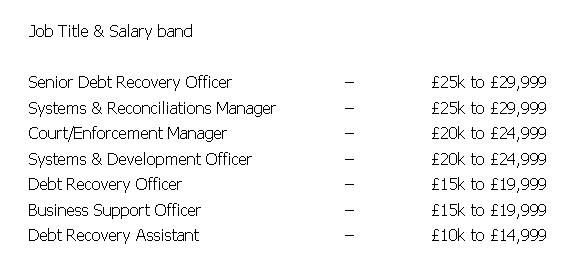
However, job descriptions going into comprehensive detail, indicate that the allocation of employee hours would be a tiny proportion of those the council claim to be attributable.
Presuppose all posts identified, existed solely for the purpose of producing and issuing summons, and 100% of employee hours were dedicated to this.
Even if the total employment costs were factored into the calculation using the maximum salary for each band, this would amount to less than 15% of the total £1.13 million total annual budget. Of course the reality is, the actual figure will be a tiny fraction of this.
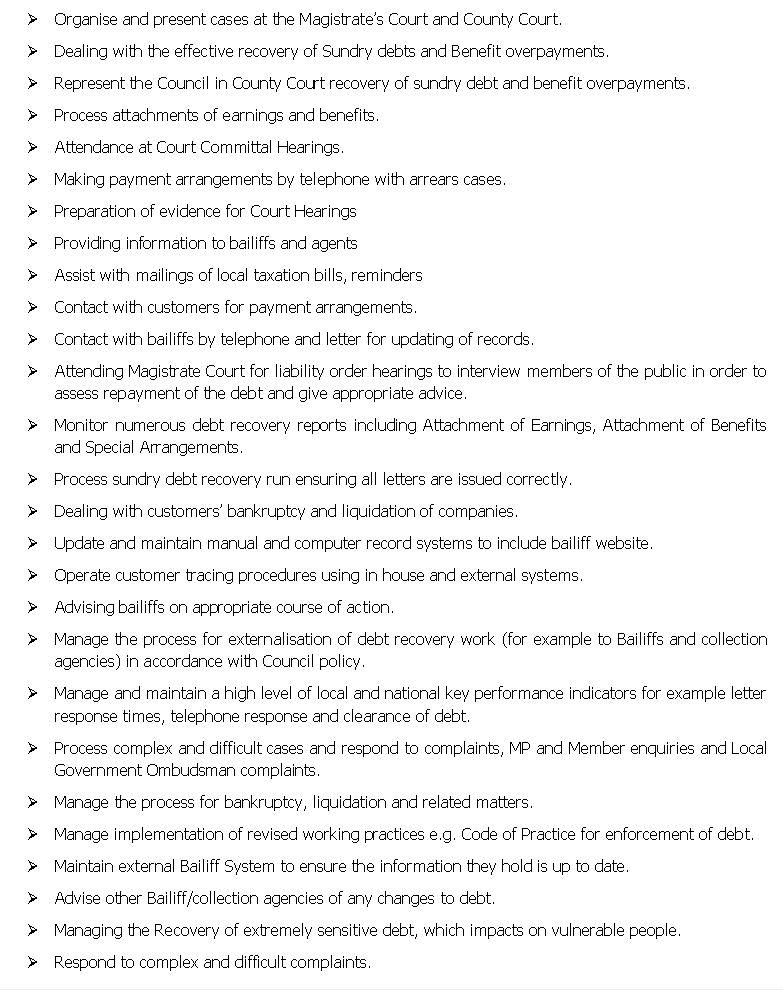
A broad range of duties are listed in the job descriptions, including (in particular enforcement and recovery posts) activities associated with different aspects of debt recovery. Many of the activities fall outside the description of what the Council Tax regulations allow as recoverable costs from householders incurring the summons penalty.
Examples are detailed in the job descriptions of the posts for Debt Recovery Assistant, Debt Recovery Officer, Senior Debt Recovery Officer and Court Enforcement Manager.
The costs incurred as a consequence of the following duties, fall outside what the law allows as recoverable by way of the summons charge. The list is not exhaustive, but all activities are described in one or more of these job descriptions.
This is almost certainly a revenue scam. The true costs incurred by the authority are clearly a fraction of those dishonestly being claimed through the court. It is also clear North East Lincs residents charged with these costs, are being exploited by the Magistrates’ court and council’s joint heist operation.
Yours sincerelyLast edited by outlawlgo; 25th September 2012, 08:20:AM.Leave a comment:
-
Re: Council Tax Liability Order Applications Court Costs – Test Case
North East Lincolnshire Council
Civic Offices Knoll Street
North East Lincolnshire
DN35 8LN
Ref: NG/CTR/12912
24 September 2012
Dear Ms ......
Re: Council Tax Reminder, Summons and Recovery – Account 550xxxxxxx
Continuing the theme of council’s costs allegedly incurred in the application process for obtaining liability orders, I’ll begin by putting the number of householders affected by these charges in perspective.
After exempt accounts are removed, for example, those in receipt of full council tax benefit, the number incurring summons costs is in excess of a quarter of all bills. This has to be profiteering, when these imposed costs impinge on such a high proportion of business rates and council taxpayers.
A statement made by the council increases doubts that the Revenues Budget figures supplied (Ref: My 21 September letter) do not specifically relate to costs which have been reasonably incurred by the authority in connection with the application.
It stated that:
This means the council is inappropriately attempting to reclaim the overheads of an entire department with proceeds from summons costs imposed on the alleged debtor. Job descriptions, which will be looked at in a future correspondence, reveal that recovery team staff, do not solely dedicated their services to activities attributable to the application for liability orders.The figure £738,500, listed under "DEBT COLLECTION", represents the cost of running the recovery service and is the total revenue expenditure budget associated with the debt recovery team for 2011/12.
In a more brief account given by the council’s Chief Executive about what made up the costs, he provided the following:
The above statement further confirms that the setting of fees is not based on actual costs. In this instance the Chief Executive is admitting they are based on what other authorities charge. He also admits to including costs for obtaining the liability order in with the summons penalty. Something which is not permissible and covered in more detail in my 18 September letter.The summons penalty costs were increased to £70 in April 2011 an increase of 23%, and are now inclusive of obtaining a liability order. This increase is in line with national averages for unitary authorities, which according to the chartered institute of public finance and accountancy (CIPFA) is £78. This fee is used in order to cover the following costs:
• the cost for the use of the court
• the wages of the staff employed to collect Council Tax and Business Rates
• ICT costs
• postage
Bearing in mind the additional costs of chasing late payment of council tax the amount of summons penalty costs remain reasonable when compared with the national average and our neighbouring council's of Hull and East Riding who charge £80.
His reference to staff wages in the collection of Council Tax and Business rates adds weight to allegations that the council aims to unlawfully cover the entire cost of these operations with proceeds from penalties.
The council elaborated on the CEO’s statement in a correspondence to the Information Commissioner:
It also added in a later correspondence:North East Lincolnshire Council have not supplied the Magistrates Court with a `breakdown' of the increased summons costs. We do not hold a breakdown for the calculation of the £70 fee, as it was based on comparisons with the fees charged by neighbouring authorities (including Hull City Council and East Riding of Yorkshire Council). The figure of £70 was then compared against national averages, and as previously identified checked to ensure that the monies raised from costs would not be greater than the cost of the service.
From the consistency of the councils statements it is evident that costs over and above those reasonably incurred are being fraudulently obtained and those defrauded are subsidising a substantial proportion of the authority’s council tax and business rates administration costs.As the summons costs are based on an average figure which is not greater than the cost of the service, North East Lincolnshire Council do not therefore hold a breakdown of the composition of the fee.
The council is legally bound by laws governing administration and enforcement of council tax. It cannot lawfully apply some juvenile logic that because other authorities have got away with it, it too should be allowed to follow suit by setting its costs the same. Neither can it circumvent legislation by seeking agreement of its members to hike fees, as this quote testifies:
The council has attempted to back-up its inappropriate decision to base the summons penalty on neighbouring authorities, after seeking member’s agreement to do this as a way of plugging a hole in its finances.The decision to increase the summons charge and make no subsequent charge for a liability order was agreed by members following public consultation in relation to the budget proposals.
It has justified this by stating checks are made “to ensure that the monies raised from costs would not be greater than the cost of the service.” However, “the cost of the service” is something entirely different to “costs reasonably incurred” by the authority, so is inappropriate criteria for setting the level of the summons fee, as these correspondence confirm.
Yours sincerelyLast edited by outlawlgo; 24th September 2012, 07:43:AM.Leave a comment:
-
Re: Council Tax Liability Order Applications Court Costs – Test Case
North East Lincolnshire Council
Civic Offices Knoll Street
North East Lincolnshire
DN35 8LN
Ref: NG/CTR/12912
21 September 2012
Dear Ms ......
Re: Council Tax Reminder, Summons and Recovery – Account 550xxxxxxx
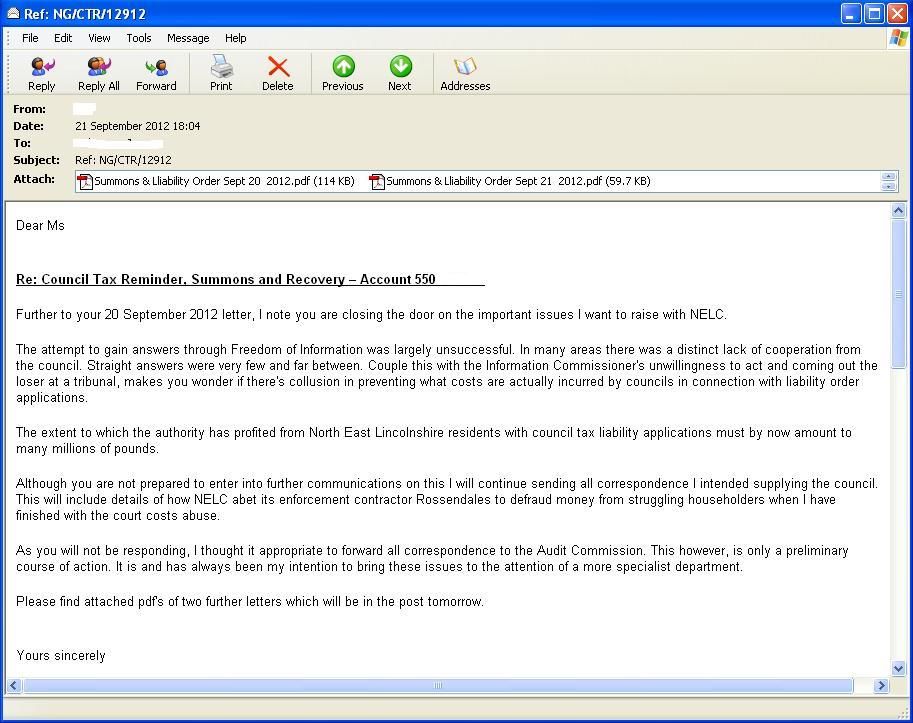
North East Lincolnshire council claim the annual figure, relating to all activity associated with recovery, is around £1.13 million. However, this figure includes no breakdown other than how much of this money is attributable to the Council tax department, Control & Monitoring and Debt Collection.
The council says its expenditure exceeds monies received from costs revenue. This would depend on your perspective, i.e. whether you considered costs, solely in relation to recovery, or, for activities more general to Council Tax Administration.
Based on an average of the last full three years data obtained, 12,644 householders incur summons costs each year. It would require each of those incurring this to pay around £90 to cover the £1.13 million the council claims it incurs.
If their calculations had any basis in reality in terms of actual costs, it would mean they were out of pocket to the tune of £20 per liability order application – its single summons fee is £70. There would be a shortfall of over £246,000 annually.
Under the Council Tax Regulations, the law allows the authority to recover costs it incurs by charging the alleged debtor. According to figures quoted by the council, it could lawfully increase this charge further and recover the £0.25 million shortfall.
From what I’ve just said, it appears I’m arguing in support of the council’s costs. I’m not; this just makes the next point I want to make easier to explain.
Which is:
There would need to be a good reason for the council electing not to recover the alleged full costs. It is likely council officers, sense, to what level fees can be hiked without having to provide a breakdown of administrative costs to the court.
Keeping costs below the court’s radar could be regarded as the safe option and avoid unwanted attention and scrutiny. Alternatively, pushing the limits may well require that the council provide supporting evidence of incurred administration costs, which could be difficult to prove.
If the authority is willing to incur annual losses of £0.25 million which could be lawfully reclaimed through the summons penalty, then the £1.13 million quoted by the council must fall under suspicion as to whether this is a credible figure.
Before analysing what appears to be the council’s exaggerated claim for costs, some perspective can be gained from drawing a simple comparison between the council’s costs for issuing summonses and a private firm providing a related service.
The council claims that it doesn’t break even by charging £70 for each summons. The figure it would need to impose on householders to cover its alleged costs would be an estimated £90 according to data obtained.
Consider the fees a private firm of bailiffs are lawfully entitled to charge an alleged debtor. A bailiff making an initial visit to a debtor’s home, with a view to levying distress, would be permitted to charge a fee of £24.50. Contrast this with the estimated £90 that the council would need to charge if it were to meet incurred cost for issuing a summons.
The figure is 267% higher than the bailiff's charge, which, if not the phantom kind, involves a dedicated visit in person to the debtor’s home. On the other hand, the council’s involvement is only administrative. Its operation being part of a bulk procedure in which thousands of summonses will all be processed at one time by its automated system.
It should raise alarm bells when private companies charge at comparatively much lower levels than the council, especially when these fees cover bailiff's and office staff's wages and additionally keep company directors etc, in the millions to which they have become accustomed.
The council has stated that:
So it seems the council is unlawfully financing COUNCIL TAX COLLECTION and recovery operations with money it charges residents in respect of the summons. Or, at least, aiming to recover a large proportion of the overheads needed to run the council tax section at the expense of residents caught-out with these penalties.The costs raised are to cover the cost of COUNCIL TAX COLLECTION and recovery.
This appears to extend to expenditure which is not specifically dedicated to recovery work.
The data below was provided by the council and is claimed to be its annual budget for all activity associated with recovery of Council Tax and Business rates. It amounts to around £1.13 million.It is not obvious how the costs are linked with applications for liability orders. What could be an arbitrary amount for recovery work is taken from the total expenditure of each category, giving a total cost attributable to Council Tax recovery. If the data is supposed to function as a breakdown and justification of reasonable costs incurred, the absence of detail renders it entirely useless.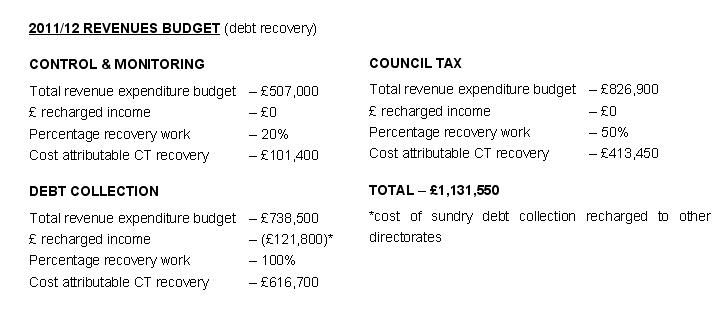
The vast sums involved do however reinforce the assertion that the council considers, at least costs for administering Council Tax, to be valid expenditure for recovery, and to be largely funded by costs charged to the council taxpayer. This will be more closely looked at and details sent to you shortly.
Yours sincerelyLast edited by outlawlgo; 21st September 2012, 18:08:PM.Leave a comment:
-
Re: Council Tax Liability Order Applications Court Costs – Test Case
Leave a comment:
-
Re: Council Tax Liability Order Applications Court Costs – Test Case
The council's first response here is pretty much what I anticipated
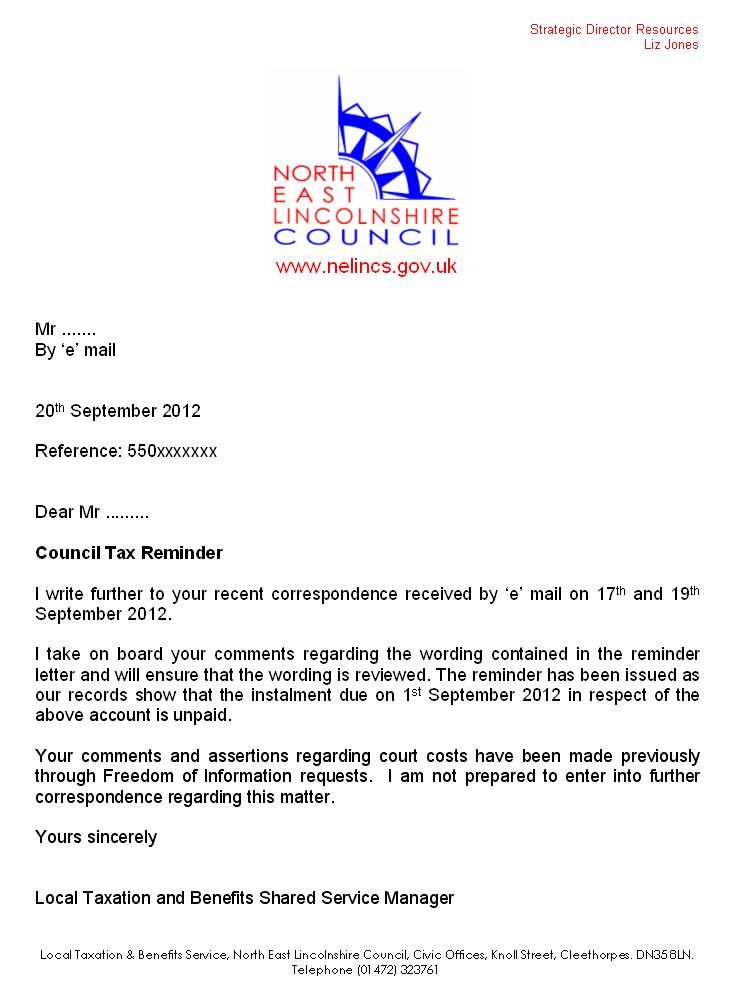
The comments and assertions referred to in the council's letter were deemed too difficult or uncomfortable to provide straight answers to when put to it under the Freedom of Information Act. I suppose that situation has not changed.
I will be continuing raising the concerns I had planned for bringing to the attention of North East Lincolnshire council. However, as the council has retreated into its safe haven of dumb silence, I will also be forwarding all correspondence to the Audit Commission to seek its perspective on these matters.
EDIT:
Due to a cash flow situation it's unlikely that a payment will reach the council in time to stop it withdrawing the instalment facility, and the temporary financial situation is unlikely to be resolved before the 26 September 2012 when the council's automated recovery system will trigger the issue of a summons incurring £70 costs.
The position regarding the lawfulness of this will then no doubt have to be tested with Magistrates at the Liability Order hearing.Last edited by outlawlgo; 20th September 2012, 09:48:AM.Leave a comment:
-
Re: Council Tax Liability Order Applications Court Costs – Test Case
North East Lincolnshire Council
Civic Offices Knoll Street
North East Lincolnshire
DN35 8LN
Ref: NG/CTR/12912
20 September 2012
Dear Ms ......
Re: Council Tax Reminder, Summons and Recovery – Account 550xxxxxxx
This letter substantiates my allegations that NELC determines, independently from the court, the level of costs it charges its residents. Details also demonstrate that the authority seems not to have any understanding that court costs should be decided and awarded by the courts.
Additional £38,000 per annum cost income
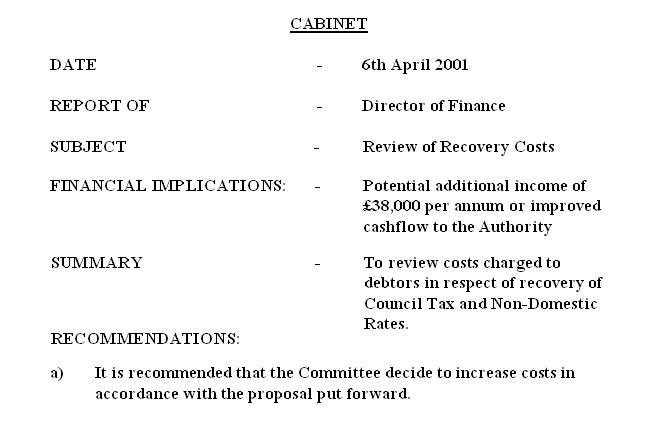
The evidence seems now to be mounting that the council is pulling the strings of the Magistrates' court and dictating the level of costs the court awards the council for liability order applications.
The court has to be satisfied that these costs are reasonably incurred by the authority. The reality is though, that the council decides when and by how much they are increased and a letter sent to the court to inform it of the changes.
From information obtained, there is no evidence that the court takes any part in determining the level of these costs the council passes on to the council taxpayer.
Another Cabinet document “Minutes of Cabinet meeting 6 April 2001” which appears unavailable on NELC's website, reveals at item reference "CAB.349" that the decision to increase costs awarded by the Magistrates' court for Council Tax and Non-Domestic Rates was not the courts but the Cabinet Committee's.
This is evidence that North East Lincolnshire council make decisions independently of the Magistrates' court and approve its own proposals to increase costs. Having no apparent need to consult with the court, the council is effectively given a free rein to increase these fees subject to its own internal approval and without providing any proof that its incurred costs have increased.CAB.349
REVIEW OF RECOVERY COSTS
Cabinet considered a report from the Director of Finance proposing a review of costs charged to debtors in respect of recovery of Council Tax and Non-Domestic Rates.
KB asked for clarification of paragraph 4 of the report regarding Liability Order increases. AE responded that the amount charged for a Liability Order for both Council Tax debts and Non-Domestic Rates would increase from £32.50 to £35. The Summons cost for Non-Domestic Rates would rise from £10 to £30.
Recommended to Cabinet Committee
That approval be given to increase costs in accordance with the proposal put forward in the report now submitted.
These fees are increased by the council as an easy option whenever it needs to generate additional income. On this occasion the increase was intended to raise additional income of £38,000 a year and was detailed in the “Cabinet meeting 6 April 2001” document.
Blatant disregard for legislation in the Council Tax Administration Regulations is the recurring theme here too. The increase had been proposed and approved by the council with no supporting evidence that any increased costs had been incurred.
There was however, an added disturbing twist for the motive behind increasing the summons cost of the Non-Domestic Rates by 200% in addition to the extra for a liability order.
The rise in the business rates penalty wasn’t to mirror a 200% increase in incurred recovery costs. This hike was purely a way of encouraging prompt payment.
Processes for Council Tax and Non-Domestic Rates Liability Order applications are identical, so proving a difference in administration costs could be tricky if the court required it to do so. However, as the council are left to their own devices, it is unlikely the Magistrates' court would have asked the authority for any justification.
The council had unlawfully manipulated the summons costs of Non-Domestic Rates to a level three times that for Council Tax, even though the processes for Liability Order applications are identical.
It states at item 5 of the 6 April Cabinet document:
The cost of issuing a summons should only take into account the administration involved and not a “deterrent” element, as there is nothing in the legislation to support an increase in costs on this basis.5. The decision to charge more in respect of Non-Domestic Rates is one which other local authorities are taking in increasing numbers. (There are two in this region currently, Bradford and Sheffield.) The reasoning behind this is that it is believed that some businesses deliberately delay payment of Rates as the penalty for late payment is so small in comparison to the amount that might be owed. The extra cost is seen as a way of encouraging prompt payment.
It may well have been an effective measure for improving cash flow, but there can be no doubt that exploiting costs this way is entirely criminal.
In future correspondence I will be deciphering, reading between the lines or interpreting the various items of cryptic information that North East Lincolnshire council has reluctantly supplied with regards its breakdown of costs.
Yours sincerelyLast edited by outlawlgo; 20th September 2012, 07:03:AM.Leave a comment:
-
Re: Council Tax Liability Order Applications Court Costs – Test Case
North East Lincolnshire Council
Civic Offices Knoll Street
North East Lincolnshire
DN35 8LN
Ref: NG/CTR/12912
19 September 2012
Dear Ms ......
Re: Council Tax Reminder, Summons and Recovery – Account 550xxxxxxx
Further to my 18 September letter, I have now sorted the relevant documents so I can furnish further evidence to support claims that penalty increases have been imposed on North East Lincolnshire residents for purposes other than compensating a corresponding increase in incurred costs to the council.
Increase summons costs to fund additional staff
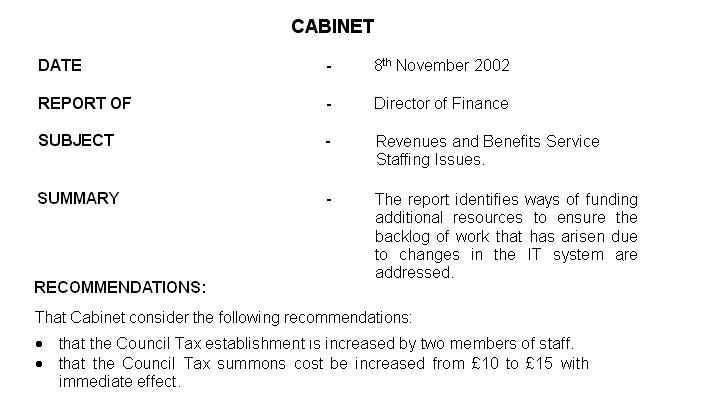
A cabinet document from November 2002 addressed staffing issues and the backlog of work created within the council’s Revenues and Benefits department due to problems encountered with IT systems.
The document highlighted that employing extra staff in the Council tax department was funded by raising the summons penalty by 50%.
At a weekly cost of almost £1,200 for each worker, a total of around £9,500 was paid out each week to hire agency staff in Revenues and Benefits to overcome problems brought about by complications in implementing a new IT system.
However, it is more relevant to focus on how the council funded extra members of staff to sort out the IT issues. It was council taxpayers, penalised by summons costs who more than funded these extra members of staff because of a correspondingly disproportionate increase in the Summons fee. This of course reinforces the assertion that the council uses liability order applications as an instrument to manipulate income generated by the authority for purposes other than costs incurred specifically for the work attributable to issuing the summons.
The document implied that the Council could rely on at least 6,000 residents would be caught out each year by the Summons fee thus raising in excess of the additional £30,000 required to fund two extra staff to clear the backlog of work caused by IT complications.
However, the figure based on the subsequent three years average was not 6,000 but 12,277 householders liable for the summons penalty. The 50% or £5 increase in the Summons fee would therefore pay for in excess of four staff; more than double what it was looking to fund by residents caught out with these penalties.
The whole picture dramatically changes when you look at how profits increased by the second year into the new arrangement. For whatever reason the summons took a further 50% hike to £30, now 200% higher than before additional staff were employed. The equivalent number of extra staff the council would be able to pay for from the additional revenue would top sixteen.
Whether or not the increased Summons cost was to fund the Council Tax establishment being increased by two members of staff or just intended as a temporary measure, the law doesn’t permit householders caught-out with costs to meet the expenditure for administrating council tax.
It has been identified in two cases that inflating costs has been done unlawfully and for invalid reasons. The first, detailed in my 18 September letter, served simply to generate income to plug a hole in the council’s budget and in this correspondence, to fund additional staff employed in the council tax department.
It should be noted that at no point has there been a reduction in the summons costs imposed on residents. This charge has only ever increased which would mean (in theory) that at no point had the council taken any measures to streamline operations and reduce costs the authority incurred. This seems unlikely given the increasing trend for councils to share resources, outsource services and take advantage of efficiencies which new technology brings.
I will continue with how NELC revealed in a Cabinet document that it intended to raise additional income of £38,000 a year, largely by increasing the NNDR (Business rates) summons by 200% with the intention of incentivising prompt payment.
Yours sincerelyLeave a comment:
-
Re: Council Tax Liability Order Applications Court Costs – Test Case
North East Lincolnshire Council
Civic Offices Knoll Street
North East Lincolnshire
DN35 8LN
Ref: NG/CTR/12912
18 September 2012
Dear Ms ......
Re: Council Tax Reminder, Summons and Recovery – Account 550xxxxxxx
I’m writing further to my 17 September letter in connection with the council’s reminder and threat of court action. I am now in a position to expand on my initial concerns with regards North East Lincolnshire council unlawfully hiking-up the summons penalty by 120% and front loading all costs to the initial stage of recovery.
The Council Tax Regulations are clear in stating that costs claimed should only be those which the authority reasonably incurs. They also distinguish between costs reasonably incurred in connection with the summons, regulation 34(5)(b) and those for obtaining the order, (7)(b).
34(5)(b) a sum of an amount equal to the costs reasonably incurred by the authority in connection with the application up to the time of the payment or tender,
NELC has committed a breach of these regulations by front loading all the charge to the summons fee. Combining the charges, means everybody who receives a summons, will now automatically incur liability order costs. Those who settle their debt prior to court action are unnecessarily being penalised and would not have incurred this second charge if the two fees were charged in accordance with the law – which is independently.34(7)(b) a sum of an amount equal to the costs reasonably incurred by the applicant in obtaining the order.
Council Tax Regulations state under Regulation 34 that the fees are incurred progressively. Firstly at a stage after the summons is issued (but an indeterminate time before the hearing). Secondly, at a point when the liability order is granted, if the account holder has not settled the debt.
Costs then are potentially incurred in two stages, but there is no provision in the regulations for an authority to predetermine the level. Regulations state that Costs reasonably incurred by the authority should be imposed, and no reference is made to set fees.
North East Lincolnshire Council is therefore unlawfully collecting penalties from debtors who settle their accounts prior to any court action. This procedure is not in accordance with Regulation 34(5) of the Council Tax Regulations, which requires that the authority shall not proceed with the application if the aggregate of the outstanding debt and costs reasonably incurred by the authority is paid or tendered to it.
Essentially authorities are not lawfully permitted to charge debtors the liability order costs detailed in Regulation 34(7)(b) in such circumstances; however, by charging these costs prematurely at the summons stage, they are doing exactly this.
Additional £188k annually through increased summons costs
North East Lincolnshire Council detailed in its 2011 budget proposals that it would raise a forecasted additional £752,000 over 4 years by increasing the summons cost. There was no supporting evidence to justify the increase. Hiking-up the costs and combining both the summons and liability order penalties into one were measures taken to achieve the increase in revenue.
The council is not permitted to make a profit and these costs should not be used as an instrument to manipulate income generated by the authority. This however, was blatantly the council’s intention when is set out its budget report of savings proposals. These were put forward as a result of council discussions taking part in private session where the press and public were excluded as the details were deemed to be exempt from publication.
It proposed to "Increase summons cost" and was listed in their budget proposals under the heading "Income Generation" and forecasted additional revenue of £188,000 for each of the following 4 years. Clearly this is acting outside the law when such fees are to cover Council Tax recovery, not constitute savings by way of income generation.

In another cabinet document “Council priorities, budget 2011/12 and medium term financial plan..” it reveals under the heading “Income Generation” at item 1.52, that the Magistrates' court played no part in authorising the increase in costs.
Income Generation
1.52 In relation to proposed areas for charging to be introduced, 81 per cent favoured increased charges for summonses compared to 57 per cent who supported charging for replacement bins or garden waste collections. Only 15 per cent were not in favour of any charges being introduced.
Clearly the decision to increase charges for the summons had not been brought about by additional costs incurred by the council. It was intended simply to plug a hole in its finances. This is reinforced by the proposals being put to a vote.
The law says awarded costs must be incurred, so increasing them on the strength of a ballot is clear evidence that additional incurred costs to the council was not a factor, and the decision made, simply to generate income.
In a future correspondence I will be supplying evidence from Cabinet documents etc., which supports my allegations that North East Lincolnshire council has habitually raised penalties imposed on its residents for apparently no other reason than to raise additional revenue.
Yours sincerelyLast edited by outlawlgo; 18th September 2012, 19:20:PM.Leave a comment:
Leave a comment: